
Hays County Past Residents by Era
For a Hays County address, the right source depends on the period and on the question. Recorded instruments establish a legal transfer. A tax roll supplies assessment-year context. A telephone directory records a subscriber or office at a date, not title. Census schedules capture a household only on the enumeration date. Build an era grid before searching so that a dated address clue does not become an unsupported claim about an owner or occupant.
| Source | Years It Covers | Where Held | What It Shows |
|---|---|---|---|
| EagleWeb recorded documents | Since Aug. 24, 1848 | Hays County Clerk online index | Grantor, grantee, reception number, date, type, block, lot, and related references. |
| TSLAC deed and tax records | Deeds 1848–1901; tax rolls 1848–1910 | TSLAC microfilm or library ILL | Legal transfers and assessment context, with reel and volume gaps noted. |
| Telephone directories | Digitized 1899–1954; archive holdings 1918–2019 | ResCarta, San Marcos Library, and Texas State | A dated subscriber, office, business, street, and phone listing. |
| Federal census | 1850–1880 and 1900–1920 locally listed | Library, archives, and federal access | A household on an enumeration date; the 1890 census was destroyed. |
| Sanborn, newspapers, and permits | Sanborn through the 1930s; newspaper runs vary | Local History Room, digital archive, or city contact | Building, street, event, or project context rather than proof of occupancy. |
Begin with EagleWeb for a recorded transfer, the library collections for a household clue, or TSLAC when the online index lacks an image or an older volume is needed. Preserve the original spelling, date, page or reel, and URL for every Hays County result.
Hays County Previous Residents in EagleWeb
Hays County's official recorder index is the quickest legal starting point. EagleWeb searches documents recorded since August 24, 1848. Public users can search document data, while registered access and subscription type affect image viewing or printing. The useful fields are Grantor, Grantee, reception number, start and end date, document type, subdivision, block, lot, and the related-document function. Basic name search expects a last name first. Advanced search permits independent word order, wildcards, and plus or minus terms.
The EagleWeb recorder search shows the Hays County fields used to follow a recorded trail.
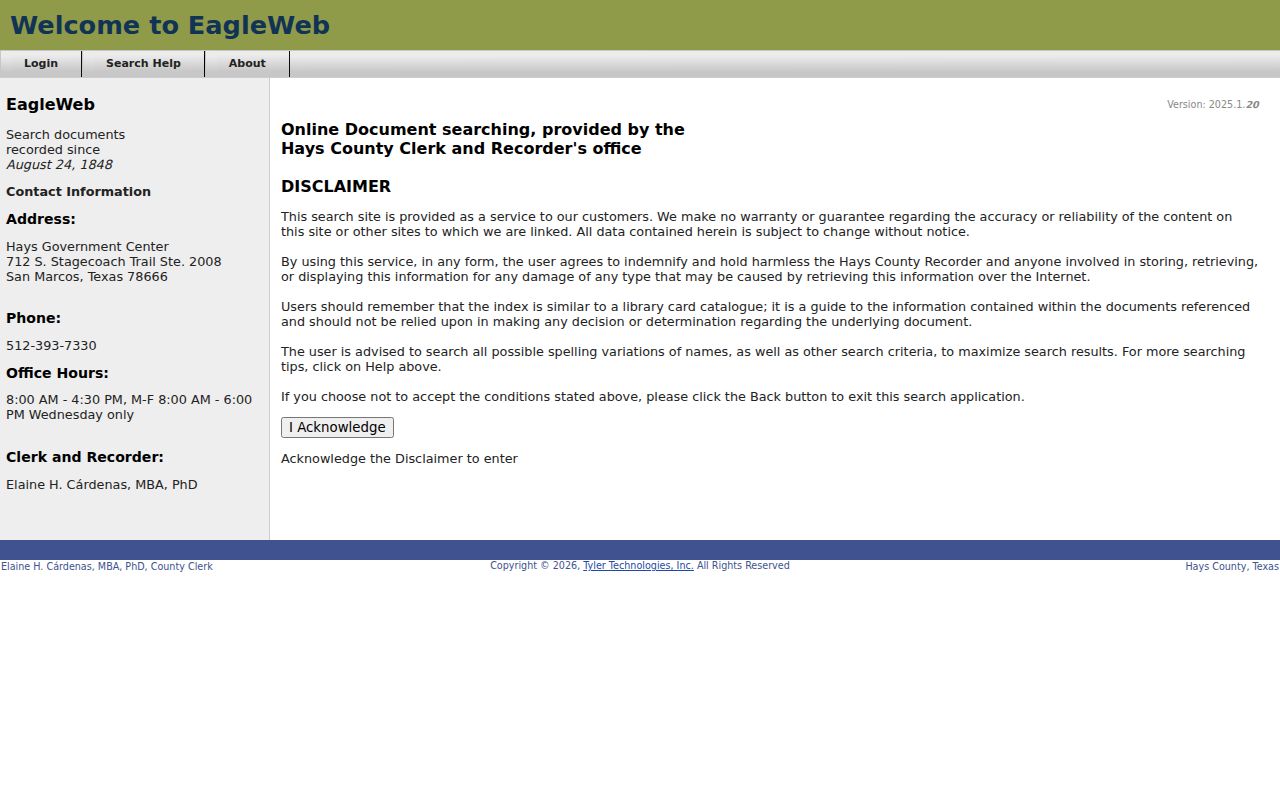
Use the record number and legal-description fields as repeatable notes. A name in the index is a lead, while an available deed image supplies the signatures, description, stamps, reservations, and other detail needed to interpret a transfer.
Hays County Previous Residents on Reels
When an online image is unavailable, the next route is not a guess. TSLAC lists Hays County deeds, probate, tax, survey, court, naturalization, marriage, death, and discharge series by reel. Its deed holdings include 1848–1901, and the deed-of-trust index covers 1870–1905 with instruments for 1874–1887. TSLAC allows onsite work in Austin or interlibrary loan through a library. The County Clerk and the Local History Room are additional local contact points for a precise series or copy question.
TSLAC's Hays County inventory identifies the microfilm series and documented gaps.
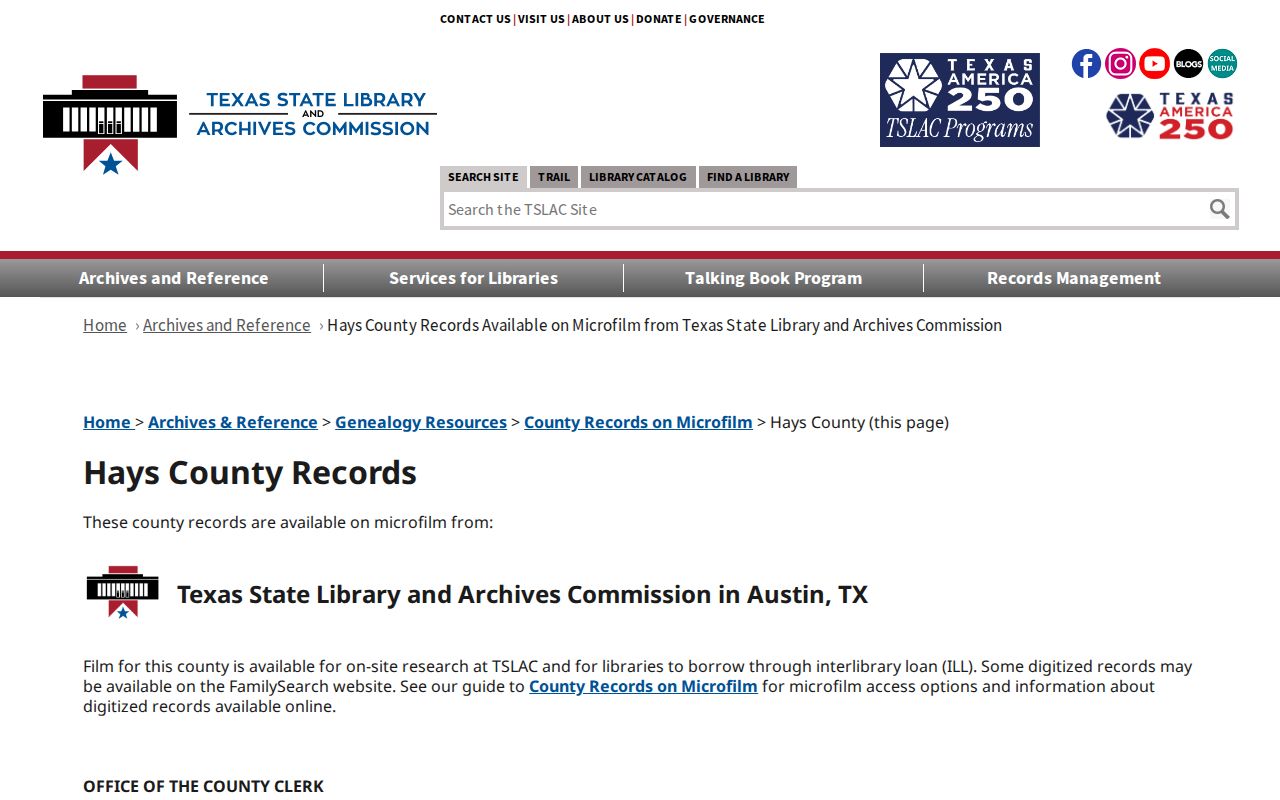
A reel citation is better than an assumed loss. Record the series title, volume, reel, index status, and image or page reference so another researcher can repeat the Hays County search.
Access also runs through the San Marcos Local History Room, Texas State University Alkek Library, the courthouse museum, and the Kyle depot. TSLAC microfilm may be requested through a library by interlibrary loan. Use the archive request form for scans or permissions, call the Local History Room at 512-393-8200 for a reservation, and use a narrow County Clerk public-information request only for existing non-exempt administrative records, not to create a house-history report.
Hays County Past Owner Deed Trail
Trace past owners in Hays County by following one legal description backward, not by treating a street number as permanent. Start with the current CAD or tax result for the parcel and assessment owner. Then find that owner as grantee in EagleWeb near the expected acquisition date. The deed should identify the grantor, legal description, reception number, and often an earlier instrument. Search the prior grantor as grantee during an earlier period, using the same lot, block, subdivision, survey, or metes-and-bounds description.
- Search Hays CAD or the Tax Office advanced search for the current situs address, then save the parcel or account ID and legal description.
- In EagleWeb, search the assessment owner as a grantee around the likely purchase period. Note the reception number, grantor, date, type, and all legal-description terms.
- Search that grantor as a grantee in an earlier date range. Confirm the same legal description before adding it to the address chain.
- Repeat one transfer at a time. Treat a deed of trust, release, plat, easement, or replat as a related instrument unless it actually transfers the legal interest.
- When the web record or image ends, ask the Clerk, the library, or TSLAC for the named book or reel. Keep the endpoint clear if a volume is missing or unindexed.
- Grantor / grantee
- The grantor transfers an interest. The grantee receives it. Their names are index terms, not a complete title opinion.
- Chain of title
- A dated sequence of instruments that traces legal interests in one parcel backward through recorded transfers.
- Legal description
- The lot, block, subdivision, survey, or metes-and-bounds language that identifies land more reliably than an address that may change.
- Reception number
- The recorder's retrieval number for a document, useful for linking a search result to its recorded instrument.
Note: A Hays County assessment name, mailing address, or homestead flag can offer context, but none alone proves who occupied the property.
Hays County Previous Residents at Library
San Marcos Public Library's Local History Room is the practical house-history stop when a deed chain needs people and dates. Its resources include vertical files, photographs, genealogical material, digitized telephone directories, obituary indexes, cemetery inscriptions, local newspapers, and the Tula Townsend Wyatt index. The room requires a reservation from 24 hours to 14 days ahead, subject to staff availability. A focused request should give the historic address exactly as written, a modern form if known, an approximate period, name variants, and the exact collection question.
San Marcos Public Library Local History gathers the Hays County entry points for historical household research.

The library does not promise a complete house-history packet or a fixed research fee. That limit matters: staff and finding aids can direct a search, while the original directory, map, page image, or microfilm record supplies the support.
Hays County Past Household Pairing
Past residents are not always past owners. A telephone directory may identify a subscriber at an address, and a city directory may provide a name or address lead, but neither is a present occupancy record. Pair each directory hit with a census year, newspaper item, obituary, cemetery transcription, probate lead, or recorded instrument only when the dates and address actually align. The 1890 federal census was destroyed, and the locally listed Hays County schedules include 1850 through 1880 and 1900 through 1920.
- Copy the directory spelling, residence or office notation, address, telephone number, year, and page.
- Compare the old street wording to a Sanborn sheet, a library street-name resource, and the current parcel's legal description.
- Use the nearest available census year as a dated household check, remembering that it records only its enumeration date.
- Search the newspaper archive or ResCarta obituary index for a move, death, organization, or relative clue, then inspect the page image instead of relying on OCR alone.
The historical volumes themselves are described in the Hays County city directories collection. For this address-focused trail, retain a distinction between a subscriber, a household member, an owner, and a probate party.
Hays County Previous Residents in Directories
The historical telephone runs are unusually useful because they cover both scanned and archival material. San Marcos Library digitized telephone directories from 1899 through 1954, while the Texas State University finding aid describes its 1918 through 2019 collection for San Marcos and surrounding communities, including Kyle, Buda, Wimberley, Dripping Springs, and Martindale. The finding aid says the collection is open without restriction, though some boxes may be off-site and require advance notice.
Texas State University's telephone-directory finding aid shows the archival request route for Hays County material.
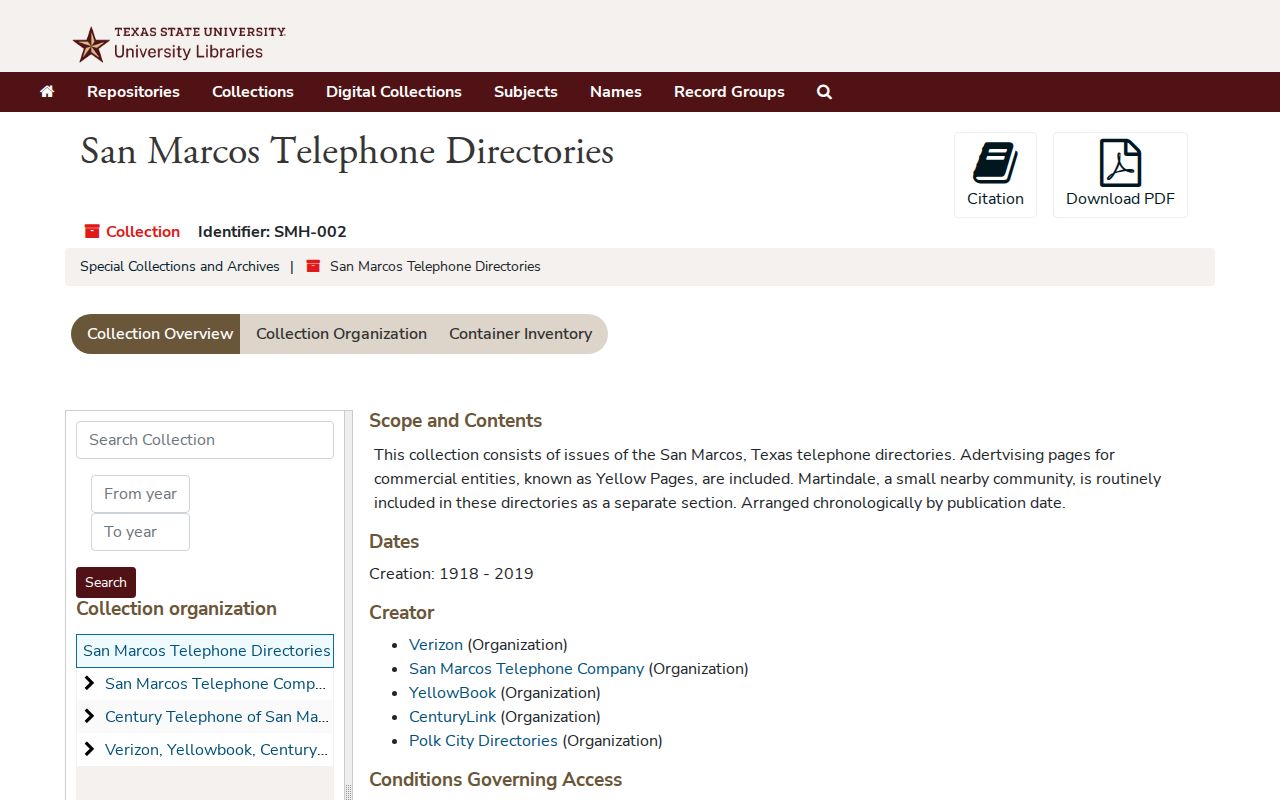
Preserve distinctions inside a listing. The inspected 1941 sample includes a residence marker, but it also contains office, business, and institutional entries. That makes it an address clue for a stated year, not proof of ownership, relationship, or current residence.
Hays County Previous Residents and Address Drift
Common misconception. An old Hays County street line can always be typed into a modern address field. The record instead may use a ranch name, mileage from town, a road endpoint, a rural route, an older postal city, or a changed municipal context. The 1941 directory includes styles such as “7 m south,” ranch, and “end of Chestnut st.” Hays County also spans San Marcos, Kyle, Buda, Wimberley, Dripping Springs, and rural areas, so preserve the original postal form before comparing it with a modern GIS or tax record.
For historic San Marcos work, transcribe the street wording and phone number, locate the block on a Sanborn map or library street-name item, query EagleWeb by name or subdivision, block, and lot, then compare CAD and GIS. Search the newspaper archive with the surname plus street or phone prefix. This sequence can distinguish an old rural route from a modern parcel without pretending the directory proves ownership.
Note: If a source fails to match, record the spelling, map date, jurisdiction, and result rather than converting the failure into a conclusion about a former household.
Hays County Previous Residents and Obituaries
Obituaries, cemetery inscriptions, and probate references can close a Hays County address trail, but each answers a narrow question. ResCarta's obituary index spans the early twentieth century through the 1980s and points to local newspaper titles. The Hays County Cemetery Inscriptions compilation was prepared in 1990 and is a transcription, not a certified death record. A newspaper can name relatives or a former street, yet its OCR and editorial text still need a page citation and corroboration.
Use the obituary or cemetery item to create a date window. Then compare it with the appropriate registrar or state eligibility route, a probate index, a directory year, and the recorded transfer history. A probate case can identify a court matter or estate relationship; it does not by itself establish that a person lived at every parcel connected to an estate.
Lawful use. Hays County house-history research is appropriate for family history, estate questions, and personal curiosity. Do not use an old address trail to track, harass, or harm a living person.