
Hays County City Directory Holdings
Hays County city directory research begins with several collections that overlap but do not mean the same thing. San Marcos telephone scans are a dated subscriber and address source. Texas State University’s archival collection extends the regional telephone shelf. Polk titles are a separate city-directory route. The San Marcos Library also supplies newspapers, obituary indexes, cemetery inscriptions, vertical files, and maps that can test a directory lead. Record the collection name, the published year, and whether the result came from a scan, a finding aid, or a physical volume.
| Collection | Years | Where Held | Access |
|---|---|---|---|
| San Marcos telephone directories | Digitized 1899-1954 | San Marcos Library ResCarta | Search scans online; preserve the directory year and page. |
| San Marcos-area telephone directories, SMH-002 | 1918-2019 | Texas State University ArchivesSpace and Alkek Library | Open collection; some boxes may be off-site and need advance notice. |
| Polk and San Marcos city directories | Texas State guide says beginning 1968 | Texas State, UT Austin, and library holdings | Ask the holding library for the exact year and availability. |
| Hays County Historical & Genealogical Society Quarterly | 1967-1978 | San Marcos Library ResCarta | Digitized secondary source for local family and community history. |
The available research does not establish a complete first-to-last Polk run or a final publication year. That is a collection gap, not evidence that no directory was printed. Search the library, Texas State, and UT Austin holdings by the specific year needed, and label any missing year as unconfirmed.
Hays County Telephone Directory Years
The telephone-directory timeline provides a practical first pass for historical city-directory work. It also explains why San Marcos cannot be treated as the only place in the collection. The Texas State finding aid includes directories for San Marcos and surrounding Kyle, Buda, Wimberley, Dripping Springs, and Martindale. A listing can therefore be a useful regional lead even when the present postal city or local boundary has changed.
- 1899-1954: San Marcos Library digitized telephone material is available through ResCarta.
- 1918-2019: Texas State University describes its San Marcos-area telephone-directory collection under SMH-002.
- 1941: An inspected phone-directory page shows name, title, residence marker, street or rural description, and phone-number fields.
- Beginning 1968: The Texas State guide identifies a Polk Directory starting point, while the complete run remains unverified.
The Texas State University telephone-directory finding aid describes the 1918-2019 collection and its request route.
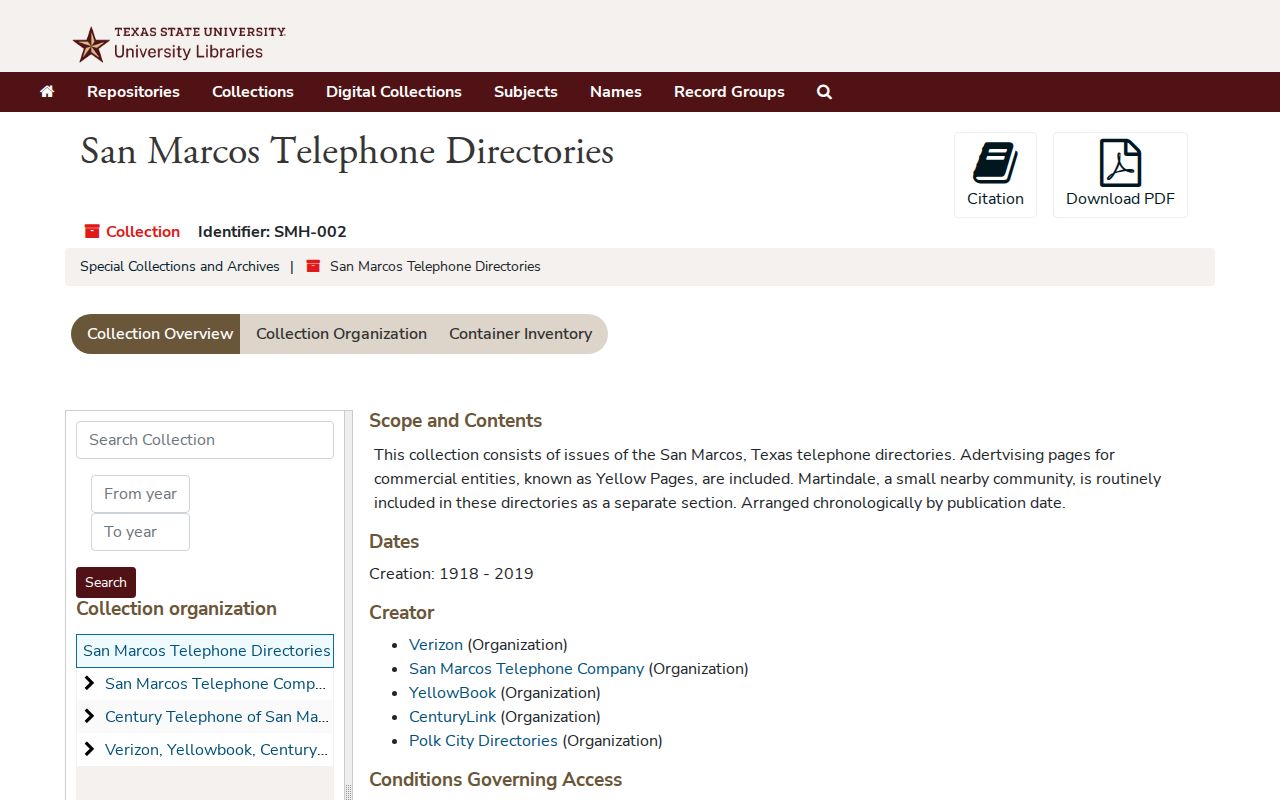
The finding aid is a route to boxes and dates, not a guarantee that every volume is digitized. Give the archive a name, approximate year, anticipated arrival date, and request note when seeking an off-site item.
Note: A directory year establishes when the publisher listed an entry, not the date someone arrived, left, bought property, or changed a household.
Hays County City Directory Library
The San Marcos Public Library is the core local stop for Hays County city directory work. Its Local History Room brings together physical vertical files, clippings, photographs, genealogical material, digitized phone directories, obituary indexes, cemetery inscriptions, newspapers, and the Tula Townsend Wyatt index. The room requires a reservation from 24 hours to 14 days ahead, subject to staff availability, and the library phone is 512-393-8200. A catalog result can lead to a physical folder instead of a digital file, so ask staff which form of access applies before visiting.
The San Marcos Public Library Local History page links the room with directories, ResCarta, newspapers, obituaries, cemetery material, and photographs.

Use the library as an access point for an exact dated source. Its historical material can connect names and places, but the record type and year still control what the item can establish.
For a scan or research request, include surname variants, an address, an approximate date, the relevant organization if any, and the collection sought. Ask whether the item is digitized, off-site, restricted, copyrighted, or available for reproduction.
Hays County Directory Transcription Tip
Transcribe a Hays County city directory entry exactly before translating it into modern language. Keep the abbreviation, punctuation, rural-distance wording, postal label, and page number. The 1941 San Marcos scan shows that entries can carry a name or title, a residence marker, a street or rural description, and a phone number. Repeated shorthand such as r or ofc can be a useful context clue, but the inspected scan did not provide an official printed key. Do not turn a context clue into a firm relationship, ownership, or present-residence claim.
| Name or title | Identifies the person, institution, or business as printed. Test initials and alternate spellings in other sources. |
|---|---|
| Residence or office marker | Shows how the publisher framed the listing. It is a listing convention, not a current-status finding. |
| Street or rural wording | May be a number and street, a route description, a ranch reference, or an endpoint from town. |
| Telephone number | Connects the entry to that year’s subscriber listing; preserve its original form. |
| Property-status field | The inspected 1941 scan did not expose one, so do not invent a status from the entry. |
A city-directory citation is strongest when it states the collection, year, page, exact transcription, and whether the item is a scan or a physical volume. That makes a later correction possible without silently replacing the historic wording.
Hays County Polk Directory Leads
Polk and San Marcos city directories should be searched as their own collection, not merged with telephone books. The Texas State guide identifies a Polk Directory beginning in 1968, and UT Austin’s Center for American History browse route identifies San Marcos and regional Polk titles. The research did not locate a public complete run or last-year inventory. Ask a library for the title, year, publisher, and location before traveling or requesting a scan.
Use the city-directory entry as a lead into another dated source. A surname and street can be checked against a newspaper page, a map, a deed’s legal description, or the census for the appropriate release year. If the question moves from a historic address to current parcel records, the Hays County street directory keeps that address-keyed work separate from the historical shelf.
San Marcos, Kyle, Buda, Wimberley, Dripping Springs, and Martindale belong in place-variant searches. A historical directory may reach beyond a modern city boundary, and the postal city printed in the volume need not match a current municipality.
Read Hays County City Directory Entries
Later directories sometimes arrange an address-oriented portion separately from the name section. Read the front matter and its key first, then note which kind of index is actually present in the volume. These terms describe common directory structures and should be applied only where the individual Hays County volume supplies that structure. They make a clear distinction between what a book prints and an inference added later.
- Criss-cross directory
- An address-ordered section, when included, that can lead from a street address to a dated listing. It is not a current people register.
- Householder index
- A name-oriented household finding aid, when a volume provides one. Check the title page and scope before relying on it.
- Abbreviation key
- The publisher’s explanation of its shorthand, often near the front of a volume. Photograph or transcribe it with the entry.
- Index versus image
- An index directs the searcher to an item; the scanned page or original volume preserves the wording used by the publisher.
When a directory entry appears to fit a family story, test it against a separate source with its own date. A newspaper OCR hit may only show two terms on the same page. A map can show a building or block, while an EagleWeb instrument addresses a legal property interest. Neither alone proves that the directory subject was the same person.
Hays County Archives and Microfilm
TSLAC is the archive route when a city-directory lead needs an older local record. Its Hays County inventory includes deed, marriage, probate, court, naturalization, tax, survey, death, and discharge series with dates and reel information. Some series are indexed, some are not, and the inventory notes gaps. Research can be done onsite in Austin or, where permitted, through library interlibrary loan. The archive is a fallback for missing online items, not proof that a missing record was destroyed or never existed.
The TSLAC Hays County microfilm inventory identifies the county record series and their reel-level coverage.
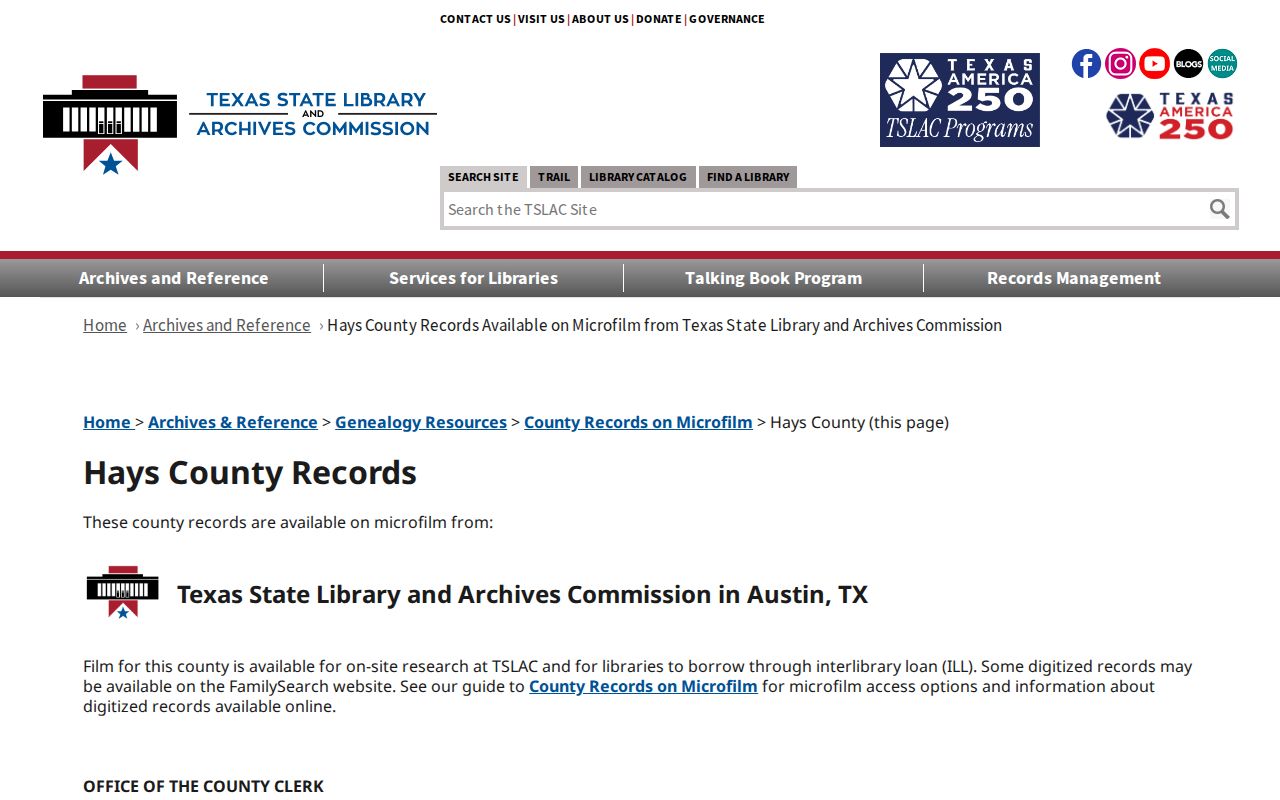
Use an archive record to corroborate a date, legal description, or family event that a directory suggests. Cite the reel or book, page, collection, and access date so a researcher can locate the same source.
The Hays County Historical Commission and its courthouse museum and Kyle depot are additional local-history contacts, though the research found no detailed public holdings catalog or fixed research-fee schedule. The library’s 1967-1978 Quarterly is a documented secondary source, not a certified record.
Hays County Directory Coverage Gaps
A missing name does not prove that a person was absent from Hays County, and a listing does not prove a present relationship to the printed address. A directory can omit people who were not subscribers, include an office or institution, use initials, carry an old address, or have a gap in the accessible run. The 1890 federal census was destroyed, and the first-to-last Polk span was not confirmed by the official sources inspected. State the gap plainly instead of filling it with an assumed story.
Historical material has privacy and time limits. Date every entry. Do not reproduce an exact date of birth, protected address, or unnecessary family detail. A current official record, when needed, should be checked with the responsible custodian and handled independently from the historical city-directory citation.
Note: Treat a historical directory as a dated lead, then use a separate primary source to verify identity, place, or legal interest.
Trace Hays County City Directories
Trace a household across Hays County city directories one year at a time. A move, a changed initial, an office listing, or a missing entry can point to the next source, but each needs corroboration. The workflow is strongest when every observation remains tied to a volume and date. It avoids treating a list of printed names as a modern household record.
- Find the earliest confirmed directory entry for the name, place, or phone number and transcribe it exactly.
- Follow the entry forward and backward through available years, noting each address, listing type, title, and phone change.
- Search the same year in ResCarta, local newspapers, maps, or a census release to test the place and identity.
- For a street-based historic lead, compare the original wording with a Sanborn map, deed legal description, or current parcel only when the sources support the connection.
- Close the research note with the volume year, page, source URL or repository, and any unresolved gap.
A disappearance can reflect a move, a death, a changed listing practice, a missing volume, or a non-subscriber. Use the obituary index, cemetery transcription, newspaper image, court or probate material, or a later directory as separate dated checks. The result should say “appears in the directory” rather than turn one historic entry into a claim about the present.